Section 6.5 Cauchy Integral Formulas

We now present some major results in the theory of functions of a complex variable. The first one is known as Cauchy ’s integral formula. It shows that the value of an analytic function \(f\) can be represented by a certain contour integral. The \(n^{th}\) derivative, \(f^{(n)}(z)\text{,}\) has a similar representation. In ChapterΒ 7, we use these results to prove Taylor’s theorem and also establish the power series representation for analytic functions. The Cauchy integral formulas are a convenient tool for evaluating certain contour integrals.

Proof.

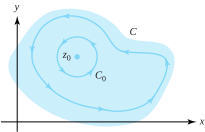
Because \(f\) is continuous at \(z_0\text{,}\) if \(\varepsilon >0\) is given there is a \(\delta >0\) such that the positively oriented circle \(C_0=\{z:|z-z_0| = \frac{1}{2}\delta\}\) lies interior to \(C\) (as FigureΒ 6.5.2 shows) and such that
\begin{equation} |f(z) -f(z_0)| \lt \varepsilon \quad \text{whenever} \quad |z-z_0| \lt \delta \text{.}\tag{6.5.2} \end{equation}
Figure 6.5.2. The contours \(C\) and \(C_0\) in the proof of Cauchy ’s integral formula
Since \(f(z_0)\) is a fixed value, we can use the result of CorollaryΒ 6.3.15 to conclude that
\begin{equation} f(z_0) = \frac{f(z_0)}{2\pi i}\int_{C_0}\frac{dz}{z-z_0} = \frac{1}{2\pi i}\int_{C_0}\frac{f(z_0)}{z-z_0}\,dz \text{.}\tag{6.5.3} \end{equation}
By the deformation of contour theorem (TheoremΒ 6.3.12),
\begin{equation} \frac{1}{2\pi i}\int_C\frac{f(z)}{z-z_0}\,dz = \frac{1}{2\pi i}\int_{C_0}\frac{f(z)}{z-z_0}\,dz\text{.}\tag{6.5.4} \end{equation}
Using Inequality (6.5.2)Β and Equations (6.5.3) and (6.5.4) above, together with the ML inequality (TheoremΒ 6.2.19), we obtain the following estimate:
\begin{align*} \left|\frac{1}{2\pi i}\int_C\frac{f(z)}{z-z_0}\,dz - f(z_0) \right| \amp = \left|\frac{1}{2\pi i} \int_{C_0}\frac{f(z)}{z-z_0}\,dz - \frac{1}{2\pi i} \int_{C_0}\frac{f(z_0)}{z-z_0}\,dz\right|\\ \amp \le \frac{1}{2\pi}\int_{C_0}\frac{|f(z) -f(z_0)|}{|z-z_0|}\,|dz|\\ \amp \le \frac{1}{2\pi}\frac{\varepsilon}{(\frac{1}{2}) \delta } \pi \delta\\ \amp = \varepsilon \text{.} \end{align*}
This calculation proves the theorem because \(\varepsilon\) can be made arbitrarily small.

Example 6.5.3.

Show that \(\int_{C_2^+(0)}\frac{\exp z}{z-1}\,dz = i 2\pi e\text{.}\)
Solution.
Recall that \(C_2^+(0)\) is the circle centered at 0 with radius 2 and having positive orientation. We have \(f(z) = \exp z\) and \(f(1)=e\text{.}\) The point \(z_0=1\) lies interior to the circle, so Cauchy ’s integral formula implies that
\begin{equation*} e = f(1) = \frac{1}{2\pi i}\int_C\frac{\exp z}{z-1}\,dz\text{.} \end{equation*}
Multiplication by \(2\pi i\) establishes the desired result.

Example 6.5.4.

Show that \(\int_{C_1^+(0)}\frac{\sin z}{4z+\pi}\,dz = i\left(-\frac{\sqrt{2}\pi}{4}\right)\text{.}\)
Solution.
Here we have \(f(z) = \sin z\text{.}\) We manipulate the integral and use Cauchy ’s integral formula to obtain
\begin{align*} \int_{C_1^+(0)}\frac{\sin z}{4z+\pi}\,dz \amp = \frac{ 1}{4}\int_{C_1^+(0)}\frac{\sin z}{z+(\frac{\pi}{4})}\,dz\\ \amp = \frac{1}{4}\int_{C_1^+(0)}\frac{f(z)}{z-(-\frac{\pi}{4})}\,dz\\ \amp = \frac{1}{4}(2\pi i) \, f\!\left(\!-\frac{\pi}{4}\right)\\ \amp = \frac{\pi i}{2}\sin\!\left(\!-\frac{\pi}{4}\right) = -\frac{\sqrt{2}\pi i}{4}\text{.} \end{align*}

Example 6.5.5.

Show that \(\displaystyle\int_{C_1^+(0)}\frac{\exp (i\pi z)}{2z^2-5z+2}\,dz=\frac{2\pi}{3}\text{.}\)
Solution.
We see that \(2z^2-5z+2 = (2z-1)(z-2) = \frac{1}{2}(z-\frac{1}{2})(z-2)\text{.}\) The only zero of this expression that lies in the interior of \(C_1(0)\) is \(z_0 = \frac{1}{2}\text{.}\) We set \(f(z) = \frac{\exp (i\pi z)}{{z-2}}\) and use TheoremΒ 6.5.1 to conclude that
\begin{align*} \int_{C_1^+(0)}\frac{\exp (i\pi z)}{2z^2-5z+2}\,dz \amp = \frac{1}{2}\int_{C_1^+(0)}\frac{f(z)}{z-\frac{{1}}{2}}\,dz\\ \amp = \frac{1}{2}(2\pi i) \, f\!\left(\frac{1}{2}\right)\\ \amp = \pi i\frac{\exp (\frac{i\pi}{2})}{\frac{{1}}{2}-2}\\ \amp = \frac{2\pi}{3}\text{.} \end{align*}
We now state a general result that shows how to accomplish differentiation under the integral sign. The proof is in some advanced texts. See, for instance, Rolf Nevanlinna and V. Paatero, Introduction to Complex Analysis (Reading, Mass.: Addison-Wesley, 1969), Section 9.7.
We now generalize TheoremΒ 6.5.1 to give an integral representation for the \(n\)th derivative, \(f^{(n)}(z)\text{.}\) We use Leibniz’s rule in the proof and note that this method of proof serves as a mnemonic device for remembering TheoremΒ 6.5.7.

Proof.

Because \(f^{(0)}(z_0) = f(z_0)\text{,}\) the case for \(n=0\) reduces to TheoremΒ 6.5.1. We now establish the theorem for the case \(n=1\text{.}\) We start by using the parameterization
\begin{equation*} C:z = z(t) \quad \text{and} \quad dz = z\,'(t)\,dt, \quad \text{for} \quad a \le t \le b\text{.} \end{equation*}
Next we use TheoremΒ 6.5.1 and write
\begin{equation} f(z_0) = \frac{1}{2\pi i}\int_C\frac{f(z)}{z - z_0}\,dz = \frac{1}{2\pi i}\int_a^b\frac{f\big(z(t)\big)z\,'(t)}{z(t) - z_0}\,dt\text{.}\tag{6.5.6} \end{equation}
The integrand on the right side of EquationΒ (6.5.6) is a function \(g(z_0,t)\) of the two variables \(z_0\) and \(t\text{,}\) where
\begin{equation*} g(z_0,t) = \frac{f\big(z(t)\big) z\,'(t)}{z(t) - z_0} \quad \text{and} \quad \frac{\partial g}{dz_0}(z_0,t) = g_{z_0}(z_0,\,t) = \frac{f\big(z(t)\big) z\,'(t)}{\big(z(t)-z_0\big)^2}\text{.} \end{equation*}
Moreover, \(g(z_0,t)\) and \(g_{z_0}(z_0,t)\) are continuous on the interior of \(C\text{,}\) which is an open set. Applying Leibniz’s rule to EquationΒ (6.5.6) gives
\begin{equation*} f\,'(z_0) = \frac{1}{2\pi i}\int_a^b\frac{f\big(z(t)\big) z\,'(t)}{\big(z(t)-z_0\big)^2}\,dt = \frac{1}{2\pi i}\int_C \frac{f(z)}{(z-z_0)^2}\,dz\text{,} \end{equation*}
and the proof for the case \(n=1\) is complete. We can apply the same argument to the analytic function \(f\,'\) and show that its derivative \(f\,''\) is also represented by EquationΒ (6.5.5) for \(n=2\text{.}\) The principle of mathematical induction establishes the theorem for all integers \(n \ge 0\text{.}\)

Example 6.5.8.

Let \(z_0\) denote a fixed complex value. Show that, if \(C\) is a simple closed positively oriented contour such that \(z_0\) lies interior to \(C\text{,}\) then for any integer \(n \ge 1\text{,}\)
\begin{equation} \int_C\frac{1}{z-z_0}\,dz=2\pi i, \quad \text{and} \quad \int_C\frac{1}{(z-z_0)^{n+1}}\,dz = 0\text{.}\tag{6.5.7} \end{equation}
Solution.
We let \(f(z)=1\text{.}\) Then \(f^{(n)}(z)=0\) for \(n \ge 1\text{.}\) TheoremΒ 6.5.1 implies that the value of the first integral in Equations (6.5.7) is
\begin{equation*} \int_C\frac{1}{z-z_0}\,dz = 2\pi i f(z_0)=2\pi i\text{,} \end{equation*}
and TheoremΒ 6.5.7 further implies that
\begin{equation*} \int_C\frac{1}{(z-z_0)^{n+1}}\,dz = \frac{2\pi i}{n!}f^{(n)}(z_0)=0\text{.} \end{equation*}
This result is the same as that proven earlier in CorollaryΒ 6.3.15. Obviously, though, the technique of using TheoremsΒ 6.5.1 and TheoremΒ 6.5.7 is easier.

Example 6.5.9.

Show that \(\displaystyle\int_{C_2^+(0)}\frac{\exp(z^2)}{(z-i)^4}\,dz = \frac{-4\pi}{3e}\text{.}\)
Solution.
If we let \(f(z)=\exp(z^2)\text{,}\) then a straightforward calculation shows that \(f^{(3)}(z)=(12z+8z^3) \exp(z^2)\text{.}\) Using Cauchy ’s integral formulas with \(n=3\text{,}\) we conclude that
\begin{equation*} \int_C\frac{\exp(z^2)}{(z-i)^4}\ dz=\frac{2\pi i}{3!}f^{(3)}(i)=\frac{2\pi i}{6}\frac{4i}{e}=\frac{-4\pi}{3e}\text{.} \end{equation*}
We now state two important corollaries of TheoremΒ 6.5.7.

Proof.

For each point \(z_0\) in \(D\text{,}\) there exists a closed disk \(\left\vert z-z_0\right\vert \le R\) that is contained in \(D\text{.}\) Using the circle \(C=C_R^+(z_0)\) in TheoremΒ 6.5.7 yields the result that \(f^{(n)}(z_0)\) exists for all integers \(n \ge 0\text{.}\)

Remark 6.5.11.

This result is interesting, as it illustrates a big difference between real and complex functions. A real function \(f\) can have the property that \(f\,'\) exists everywhere in a domain \(D\text{,}\) but \(f\,''\) exists nowhere. CorollaryΒ 6.5.10 states that if a complex function \(f\) has the property that \(f\,'\) exists everywhere in a domain \(D\text{,}\) then, remarkably, all derivatives of \(f\) exist in \(D\text{.}\)

Proof.

For each point \(z_0=(x_0, y_0)\) in \(D\) there exists a disk \(D_R(z_0)\) that is contained in \(D\text{.}\) In this disk, a conjugate harmonic function \(v\) exists, so the function \(f(z) =u+iv\) is analytic. We use the Cauchy-Riemann equations to get \(f\,'(z)=u_x+iv_x=v_y-iu_y\text{,}\) for \(z\in D_R(z_0)\text{.}\) Since \(f\,'\) is analytic in \(D_R(z_0)\text{,}\) the functions \(u_x\) and \(u_y\) are harmonic there. Again, we can use the Cauchy-Riemann equations to obtain, for \(z\in D_R(z_0)\text{,}\)
\begin{equation*} f\,''(z) = u_{xx}+iv_{xx} = v_{yx}-iu_{yx}=-u_{yy}-iv_{yy} \text{.} \end{equation*}
Because \(f\,''\) is analytic in \(D_R(z_0)\text{,}\) the functions \(u_{xx}\text{,}\) \(u_{xy}\text{,}\) and \(u_{yy}\) are harmonic there.

Exercises Exercises

Recall that \(C_{\rho }^+(z_0)\) denotes the positively oriented circle \(\{z:|z-z_0| = \rho \}\text{.}\)

2.

Evaluate \(\int_{C_1^+(1)}(z+1)^{-1}(z-1)^{-1}\,dz\text{.}\)

9.

Evaluate \(\int_{C_1^+(0)}z^{-n}\exp z\,dz\text{,}\) where \(n\) is a positive integer.
Solution.
\(\frac{2\pi i}{(n-1) !}\text{.}\)

16.

Let \(P(z)=a_0+a_1z+a_2z^2+a_3z^3\text{.}\) Evaluate \(\int_{C_1^+(0)}P(z)z^{-n}\,dz\text{,}\) where \(n\) is a positive integer.

17.

Let \(z_1\) and \(z_2\) be two complex numbers that lie interior to the simple closed contour \(C\) with positive orientation. Evaluate
\begin{equation} \int_C(z-z_1)^{-1}(z-z_2)^{-1}\,dz\text{.}\tag{6.5.8} \end{equation}
Solution.
\(0\text{.}\)

18.

Let \(f\) be analytic in the simply connected domain \(D\) and let \(z_1\) and \(z_2\) be two complex numbers that lie interior to the simple closed contour \(C\) having positive orientation that lies in \(D\text{.}\) Show that
\begin{equation*} \frac{f(z_2)-f(z_1)}{z_2-z_1} = \frac{1}{2\pi i}\int_C\frac{f(z)}{(z-z_1)(z-z_2)}\,dz\text{.} \end{equation*}
What happens when \(z_2 \to z_1\text{?}\) Why?

19.

The Legendre polynomial \(P_n(z)\) is defined by
\begin{equation*} P_n(z)=\frac{1}{2^n n!}\frac{d^n}{dz^n}[(z^2-1)^n]. \end{equation*}
Use Cauchy ’s integral formula to show that
\begin{equation*} P_n(z) = \frac{1}{2\pi i}\int_C\frac{(\xi ^2-1)^n}{2^n(\xi -z)^{n+1}}\,d\xi\text{,} \end{equation*}
where \(C\) is a simple closed contour having positive orientation and \(z\) lies inside \(C\text{.}\)
Solution.
Let \(f(z)=(z^2-1)^n\text{,}\) which is analytic everywhere. By Cauchy ’s integral formulas, \(P_n(z) = \frac{1}{2^nn!}f\,^{(n)}(z) = \frac{1}{2^nn!}\left[\frac{n!}{2\pi i}\int_{C}\frac{f(\xi)}{(\xi -z)^{n+1}}\,d\xi\right] \text{.}\) The conclusion follows from this result. Show the details.

20.

Discuss the importance of being able to define an analytic function \(f(z)\) with the contour integral in Formula (6.5.1). How does this definition differ from other definitions of a function that you have learned?